Monday, 18 January 2021

Tyntesfield

Tyntesfield


Tyntesfield is a country mansion and estate, transformed from a Georgian house to a Victorian Gothic masterpiece - for the Gibbs family almost 200 years ago. It has a wonderful outlook across North Somerset and is now a National Trust property with something different to see whatever time of the year you visit.


Entrance into the house is by a timed-ticket that you obtain when you arrive at the park - at Home Farm Visitor Centre or you can order it online (as they do sell out on busy days). It is then a 10 minute walk from the car park to the house.


Tyntesfield's founder William Gibbs was the son of a Spanish cloth merchant; he was born in 1790 in Madrid and his life is described as being full of struggles. He always had anxieties about money, due to sacred debts he had to repay; but he made his fortune, not from cloth, but from trading in guano. Through the house, you can see countless objects that have been collected on William's travels around the world - as well as those from his beloved Spain.


There are extensive grounds with various sections of formal gardens and open fields. The terrace in front of the house here, is planted up with seasonal bedding at different times of the year.


If you walk all the way around the outside of the house, you come across some interesting features....


And out through the arch at the end of the passageway, there is a magnificent view across the countryside; a huge conservatory used to fill this space until it fell into disrepair in the War.


This quaint little building used to be a play house!


When it is your allocated time to go inside the house (you will not be allowed in any earlier), you have to give your ticket in; and you are given a guide book to help you identify specific items around the house - this book has to be left in the Chapel at the end of the visit.


The Main Hall has a beautiful wooden carved staircase, going up to the Gallery Landing - where the walls are adorned with a variety of paintings. On the ground floor there is often someone playing the piano giving such a feeling of grandeur.


This exquisite stone fireplace was specially designed by the Gibbs family - with lofty statues around the top depicting Temperance, Fortitude, Prudence, Justice and Truth.


The library was added about 1863 and contains over 3000 books; it has been used as a sitting and reading room by the family, and was also where they staged theatrical shows.


The dining room with it's impressive columns was originally smaller than it is today; but nevertheless, the family were served their meals by 2 footmen in order of importance (guests first, then the family), whilst the children ate in the nursery.


This room is the Oratory, but was being used as a storage room when I visited - they rotate which rooms are being renovated and used for storage - there are over 60,000 objects in the house.


Throughout the building you can see fascinating pieces collected from all over the world. William Gibbs travelled extensively whilst working for his father, mainly from Spain and Portugal to England and later from the Americas whilst building his own empire.


There are several pieces in Mrs Gibbs room, that are miniature copies of windows and doorways from inside the palace of the Alhambra in Granada - a fortress occupied by Muslim rulers in the 14th and 15th centuries. These are exquisite souvenirs bought back from a visit to southern Spain. 


The Gibbs family enjoyed dressing up and putting on plays - especially in costumes of earlier times.


One of my favourite rooms is the Billiard Room, that is one of a group of rooms specifically designed for the men of the household and their boisterous activities.


Upstairs there are just a few rooms open to the public, a bathroom and several bedrooms. One of the more unusual things to look out for is the Gibbs medicine cabinet with over 400 bottles of remedies from all over the world - although not all can actually cure illnesses!


Further along from the bedrooms is the Clyst Lobby which was originally a bedroom corridor; but it became part of the processional route the family took when going to the Chapel. Leading on from this is the Chapel Corridor with its green painted walls (a colour that only the wealthy had, due to the high cost of manufacturing green coloured paint); and its unusual arched ceiling - letting light flood in from above.


The Chapel is one of the most fabulous rooms/buildings on the estate and is connected to the main house by a covered bridge.


William died in 1875 at the age of 84; and although his beautiful Chapel had been completed, it unfortunately wasn't licensed for services until the following year.


There are some fabulous stained glass windows all around the chapel.


On my way out of the house, I spotted the bells that rang when the Master or Mistress of the house was in need of something - and the servants would come running. Very Upstairs Downstairs!


There is much to see around the estate; if you walk down the road from the main house, you pass by the Stable yard and arrive at the Kitchen Garden area. Here is a newly restored Orangery containing tropical plants and overlooking greenhouses that are full to the brim with all manner of plants. 


There is a cafe, toilets and an outdoor seating area down in the Kitchen Garden Area - as well as a play area for children. The Pavillion Cafe opens every day at 10:30am and is an ideal place for a rest.
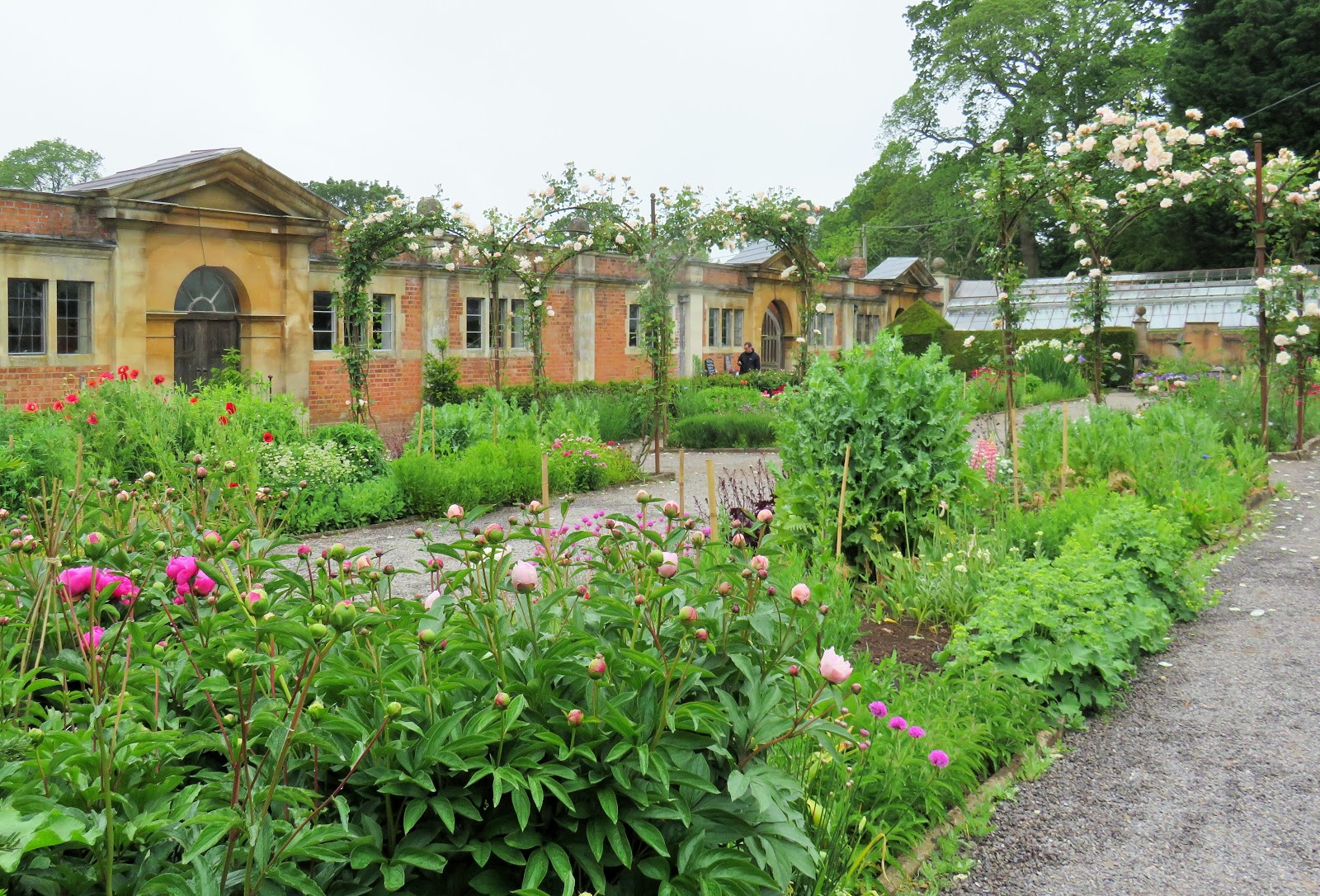

The Kitchen Garden is laid out perfectly and full of traditional produce.


It is quite a long walk back to the car park (back up the hill and past the house), about a 30 minute walk, but there is mini bus for people with limited mobility - to get back to the house and to the Visitor Centre.  It doesn't run to a specific timetable but it just keeps travelling around the estate. The last pick up from the Kitchen garden is one hour before the estate closes, times vary with the season.


Alternatively, if you fancy something different, you can opt for a ride in a horse and carriage - complete with a driver dressed in the appropriate period attire.


Further past the house is the old Sawmill - this is where electricity was originally generated (until the house was connected to mains electricity in 1952).  This building is now available for private functions.


Back at the Visitor Centre, there is plenty more to see and do! Or things to buy!


You can have a go at making something in the wood shop - under supervision of course.


There is a great cafe by the Visitor Centre - the Cow Barn restaurant, which is very much a traditional out building, selling delicious cakes and snacks - and is open from 10am every day.


Finally, I hope you like this photograph of Mabel the Tyntesfield Cow - she is there to remind everyone that Tyntesfield is a working estate with cows and sheep; and everyone should keep a look out for the areas they need to avoid. There have been livestock here since Victorian times; dogs are allowed in most areas on the estate but there are some dog-free areas - so please be aware.


I hope you have enjoyed my tour of the Tyntesfield Estate and House.

For more information - www.nationaltrust.org.uk/tyntesfield

Lynne 

Please check out my other blogs:-


Thursday, 12 November 2020

Bicton Park Botanical Gardens

Bicton Park Botanical Gardens 


Bicton Park Botanical Gardens is a wonderful Heritage garden divided into different interesting sections, each with its own attractions. The garden was established in the late 1700s, although history of the area dates back to the 8th century (originally called Beoccatun - the hamlet belonging to Beocca, a Saxon chieftain who lived in the forest on the west bank of the River Otter). There is a Timeline, tracing 1300 years of Bicton and its estate in the main entrance – which gives visitors a good insight into its fascinating history.

Today, Bicton is home to many rare plants, with origins from all parts of the world, including one of the finest collections of trees in Britain. As well as being a special place for garden enthusiasts to visit, it is somewhere families can enjoy too, with several themed adventure playgrounds as well as them being able to enjoy the Woodland railway (that passes through much of the park). 


After entering through the shop, which is always a good place to investigate at the end of the day – you come to an enclosed courtyard (The Garden Centre) with a colourful array of plants for sale, and several greenhouses teeming with bright blooms.


Through an archway in the wall, you are immediately in the 19th century Rose garden - following on to the Mediterranean Garden, which is full of drought tolerant plants – such as phormiums and cordylines. 


These grow on a sunny slope overlooking the park’s famous 300 year old Italian Garden with a magnificent blend of colour and eye catching formality. There is the most amazing view across terraced lawns, to the huge water feature below - surrounded by trees, statues and urns. 


This part of the garden was inspired by a French designer who created the gardens at Versailles, and he may actually have drawn up the original plans here in about 1735. 


The symmetrical canals around the aptly named Mirror Pond were my favourite parts, as the early morning stillness gave way to some stunning reflections – a truly memorable sight. 


Joining this area is a wooden walkthrough leading to the American and Stream garden.


This entire area is surrounded by well stocked flowerbeds – not to mention the ornate ones - filled with exotic cannas and lilies. 


The Church of St Mary can be seen over the far side of the pond, behind huge ancient trees. 


The Palm House (the 2nd largest in Britain even pre-dating Kew’s) was built in the 1820’s, - on a cast iron frame with over 18,000 panes of glass. 


It is such an impressive sight, with its tall central curved, vaulted roof and sloped side wings; and double doors leading out to the colourful garden below. It is one of Bicton’s most beautiful and impressive features - containing a spectacular collection of palms. 


Back in the Courtyard you will find the Woodland Railway Station. Bicton’s 18-inch gauge Railway was built in the 1960s as an additional attraction to the park – using decommissioned track from the Royal Arsenal munitions factory on Woolwich.


A scenic ride is an ideal way to appreciate what the park has to offer, and timed tickets need to be purchased when you first arrive at Bicton, to ensure you get a seat. It is the only 18-inch gauge leisure line left in Britain and attracts rail enthusiasts as well as families (and grown-ups wanting to enjoy the thrill a train ride offers).


The “Sir Walter Raleigh” replica engine (named after the 16th-century adventurer, who was born near Bicton), departs from Bicton station several times each day, making a picturesque 25-minute journey. You can enjoy winding through much of the parkland including the Pinetum, with its fabulous collection of trees; until you reach Hermitage Station. Here you begin the return journey, along the edge of the Great Lake – the most delightful little journey of about a mile and a half, that I can highly recommend.


Back at the courtyard area, it is an ideal time to visit the other glass houses with plants from all over the world - living in areas created to resemble their natural habitats.


The Tropical House contains lush foliage and exotic blooms including the famous Bicton Orchid that first bloomed here in 1836.


The Arid House contains some of the world's strangest plants, with cacti and other succulents growing in a desert landscape. And finally, there is the Temperate House – they are full of individual delights. 


Follow the upper path, past the Orangery Restaurant and you arrive at an area described as “a primeval rocky glade” full of exotic tree-ferns.


Hidden there is the unusual Shell House, which contains a wonderful collection of seashells from all around the world.


A series of footpaths lead down from this stone building, through boulders and greenery – eventually arriving back at the American and Stream Garden which was established in the 1830’s and has some of the loveliest trees and plants from other parts of the world, such as the Chinese handkerchief tree and Giant Gunnera. 


This area contains some of the parks most ornate trees and shrubs, and it is an ideal place for those wanting to enjoy some peace and tranquillity under the shady trees.


The Countryside Museum contains restored artefacts and pieces of machinery from days gone by. The exhibition hall is most deceiving, from the outside it doesn’t look very big – but it is packed with nostalgic delights for all generations. 


It contains traction engines, vintage machinery, traditional tools, tractors and domestic memorabilia - following 300 hundred years of history here at Bicton. 


In the 1800’s Bicton was a busy estate, and much of what is exhibited here, is what the estates’ employees would have used tending the ornamental and kitchen gardens, as well as in the running of the house and estate – including a 1831 hand-operated fire engine, that has been at Bicton House for 100 years.


The museum really is somewhere that should not be missed – it will be appreciated by young and old alike. 


Bicton’s Pinetum and Arboretum, with over 1000 magnificent trees and conifers (at least 300 different types) is another area of the parkland not to be overlooked. It has many rare and endangered species; some of the tallest and largest of their kind in the country - at 134 feet high, the champion Grecian fir is the tallest ever recorded.


 This Giant Redwood Tree sapling will grow so big that its truck will be as wide as the outer circle – in maybe 100 years’ time. 


Walking through this area of the parkland, if you follow the signs back past the Hermitage Station, you will come to the Fairy Falls – an unusual area that will delight everyone. 


Overlooking this is the Hermitage Garden, a peaceful area in one of the farthest corners of the park. The forested valley contains colourful camellias and rhododendrons, bird hives, a nature trail leading back to The Great Lake – an unspoilt area that doesn’t get too busy. 


If the little ones want busy – then Bicton’s indoor Play Barn (Play Zone) is the ideal place to keep them occupied – whatever the weather.


There are also several well-designed outdoor play areas, mini golf, a climbing area, that looks like a pirate ship, and fabulous colourful miniature cottages to have adventures in – or of course they can explore the extensive parkland.


When it is time for a rest and some refreshments, head for the restaurant - which is situated in the 18th Century Temple Orangery overlooking the Italian Garden below. It offers a vast range of options, including drinks and light snacks, as well as a variety of delicious meals. This is accessed through the shop – which is also the best place to browse before heading home. 


You can easily spend a whole day at Bicton, exploring and relaxing – in the most perfect surroundings. I thoroughly enjoyed my day and would highly recommend it.

For more information - follow this link - https://www.bictongardens.co.uk/


Thank you for taking the time to follow my adventures,

Lynne 

Please check out my other blogs:-